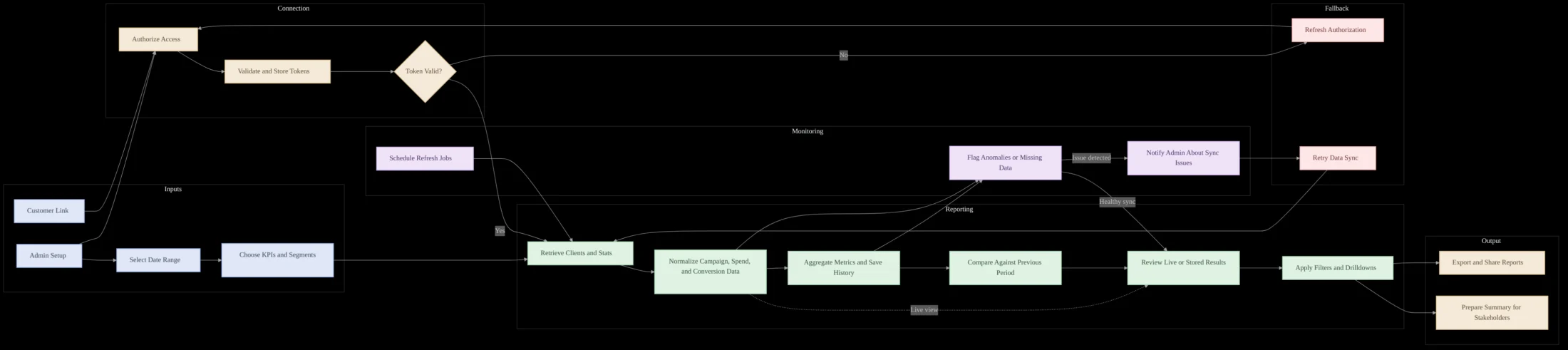
This work was shaped around a common agency problem: advertising data exists, but the day-to-day process for collecting it is fragile. Each customer has to authorise access individually, tokens expire, different people need different levels of visibility, and the raw API is not designed as a reporting workspace. The goal was to create a proper operating layer around Allegro Ads so customer setup, access control, and reporting could be handled from one place.
Customer onboarding was kept simple. An administrator creates the customer record and sends a signed authorisation link with a limited lifetime. The customer follows that link, completes Allegro consent directly, and the connection is stored against the correct account without exposing internal admin access. That reduces coordination overhead and makes the authorisation flow easier to support in day-to-day agency work.
Reporting was built with the API’s limits in mind rather than fighting them. Recent campaign data can be pulled live for short date windows when someone needs an immediate check. Longer-range reporting is handled differently: scheduled background jobs fetch daily statistics, refresh tokens when required, and save normalised records to a reporting store. That makes it possible to review performance over time without repeatedly querying the API for the same periods.
Access was also structured for real agency use. Admin users can manage customers and create viewer accounts, while viewer access can be limited to selected customer portfolios instead of exposing the full client list. Alongside the dashboard, API logging and token status tracking give the team a practical way to see what is connected, what has expired, and where a reporting issue started. The result is a tool that supports ongoing client service work rather than a one-time API connection.