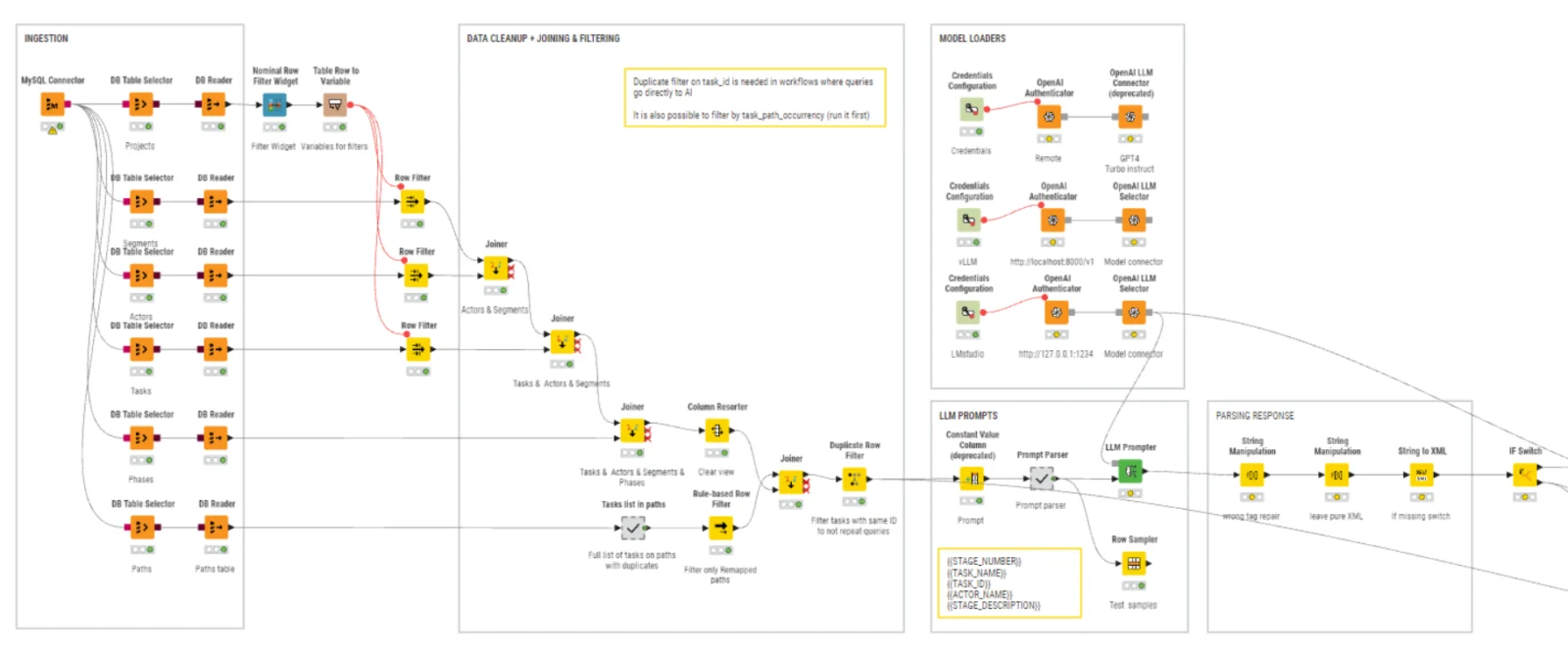
This project was built to assess bounce-risk patterns in the context of the customer journey rather than as a flat reporting metric. Instead of looking only at drop-off signals in isolation, the workflow was designed to interpret risk in relation to tasks, paths, roles, segments, and stages inside the customer journey application.
What made the workflow more useful was the addition of an AI-supported analytical layer on top of the structured journey data. Quantitative signals could show where risk might be rising, but they did not always provide enough interpretive value when the goal was to understand why a particular stage deserved closer attention. Bielik was used here to support stronger Polish-language interpretation, which made the outputs better suited to the real working context of the application.
Implemented in KNIME, the workflow brought together data preparation, journey-stage structuring, and AI-supported interpretation in one process. The result was a more context-aware view of bounce risk, helping surface which parts of the journey were weakest and where improvement work could be prioritised more effectively.