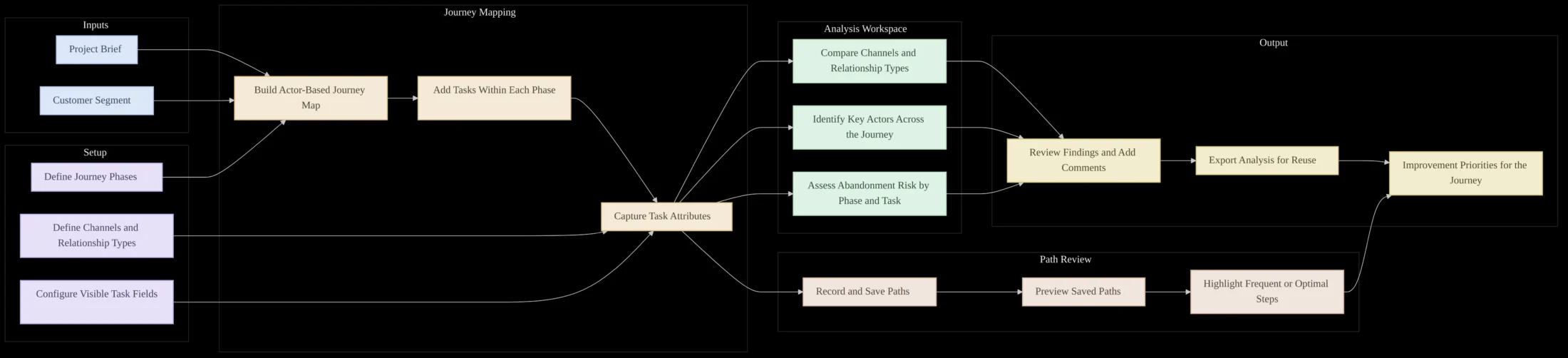
Customer journey work often loses value after the mapping session. Teams can sketch phases, touchpoints, and actors, but once the workshop ends there is rarely a reliable way to compare segments, review alternate routes, or connect the map to operational analysis. I built this application to turn journey mapping into something teams could maintain, revisit, and analyse over time.
The application gives teams a structured way to define projects, customer segments, phases, channels, relationship types, and the actors involved at each step. Journeys are built around tasks by actor and phase, which makes the model usable for real operating scenarios rather than presentation-only diagrams. Where needed, teams can capture the practical details behind each task, including expected result, bounce risk, success rate, channel effectiveness, online or offline status, frequency, and timing.
Alternate path handling was designed as a working feature, not a visual extra. Users can step through tasks in sequence, save named path variants, and reload them later for review. That matters because customer journeys are rarely single-route flows. Different segments take different paths, and even within one segment there are usually several ways a journey can progress, stall, or fail.
On top of the mapping layer, I added a focused analysis area scoped by project and segment. Teams can review abandonment risk by phase, identify high-friction tasks, compare the influence of different actors, and examine which channels or relationship patterns dominate movement through the journey. The result is a practical internal tool that helps teams move from workshop artefacts to maintainable journey knowledge and more grounded analysis.