Project

Customer Segmentation and Basket Analysis

Timeline: Q3 2025

An automated customer analytics workflow designed to turn transaction data into repeatable outputs for segmentation, basket analysis, and ongoing customer work.

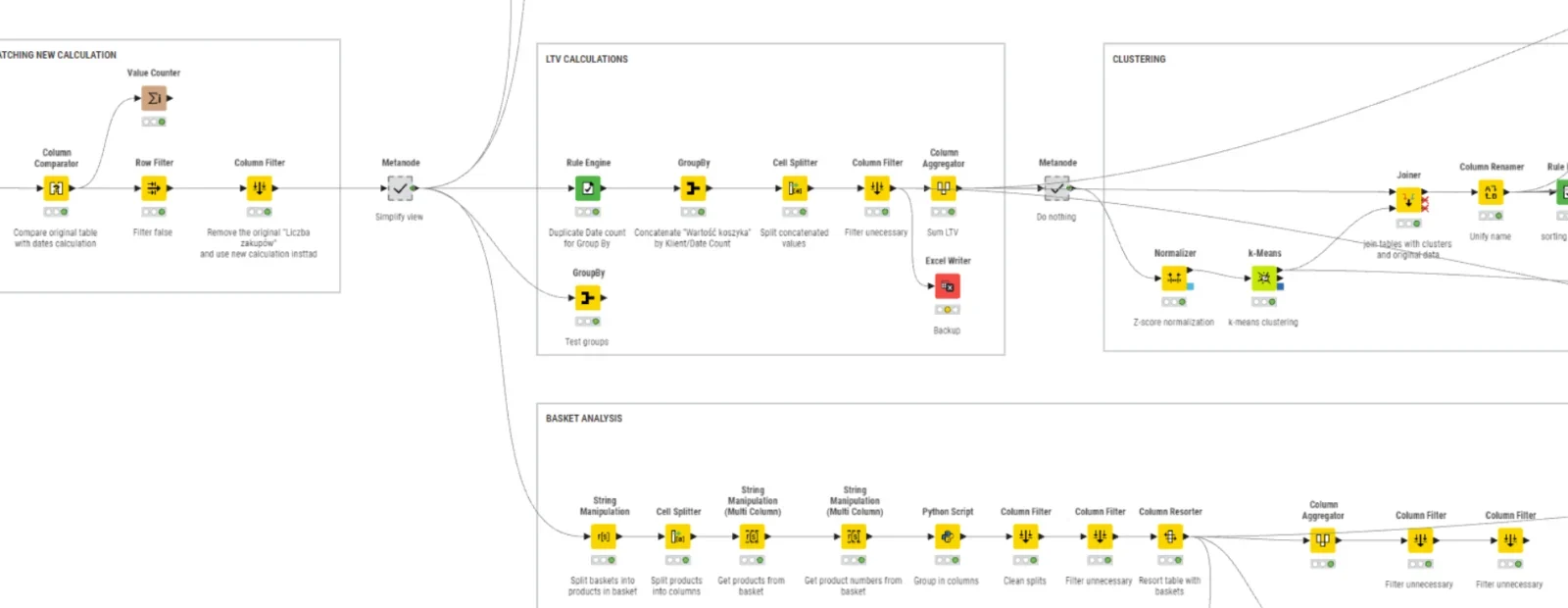
This project was built to make customer analytics more repeatable and operationally useful. Rather than treating segmentation as a one-off exercise in spreadsheets, the workflow brought data preparation, segmentation, basket analysis, and export into a single KNIME process that could be run again as new data became available.

A large part of the work was in making the analysis dependable enough for regular use. Data cleaning was essential here, because segmentation and basket analysis are only as useful as the consistency of the underlying records. Transaction data had to be prepared carefully, problematic entries had to be filtered out, and the outputs had to be structured in a way that made them usable beyond the workflow itself. That meant designing not only for analysis, but also for reuse in the customer database and related commercial work such as targeting, reporting, and ongoing customer review.

The workflow also combined two perspectives that are often handled separately: customer segmentation and basket analysis. That made it possible to look at customers as groups while also keeping sight of purchasing patterns at the product level. The result was a more useful analytical foundation for ongoing customer work than a single isolated report or one-time model run.

Challenge

The challenge was to move from ad hoc spreadsheet analysis to a repeatable customer analytics workflow. Transaction data needed to be prepared and validated carefully, and the final process had to support both segmentation and basket analysis in a form that could be reused operationally rather than rebuilt manually each time.

Solution

The solution was developed as a structured KNIME workflow covering data preparation, validation, segmentation, basket analysis, and export. It was designed to reduce manual handling, make recurring analysis more dependable, and produce outputs suitable for ongoing use in the customer database and related analytical work.

Outcome

The workflow created a repeatable process for customer segmentation and basket analysis, producing outputs that could be used directly in the customer database and in broader commercial analysis. Instead of relying on one-off manual work, the process made segmentation more consistent, easier to rerun, and easier to use in targeting, reporting, and ongoing customer decision-making.